
Viewing entries in
Investor presentation

Teach them how to think about you

Teach them how to think about you

This debate on the Fred Wilson blog whether you should look at Twitter in terms of monthly active users who log in, or (the much larger number of) people who view/get exposed to tweets is an important lesson in investor presentation design: sometimes you need to educate your audience how to think about you.

Investors like benchmarks that they can compare quickly across stocks, like features of car: EPS, CAC, churn, MAU, eye balls, beta, EV/EBITDA. If your company does not fit the traditional pattern you need to make sure your audience understands it.


Image from WikiPedia

SlideMagic: a platform for magical presentations. Free student plan available. LEARN MORE

Explaining complex things

Explaining complex things

If your technology is very complex, you have 2 challenges:

  1. Still explain the principle of the technology in a simple way
  2. Show that the incredible complexity is an asset that is hard for competitors to copy

Don't mix the two. If you cannot resist and make the explanation of the basic idea behind your technology complex, people won't get it. If you oversimplify things and hide the complexity, people will think that this is something obvious and not worth investing in.

You need to separate (sets of) slides.


SlideMagic: a platform for magical presentations. Free student plan available. LEARN MORE

Should you care about a good investor pitch?

Should you care about a good investor pitch?

Here is a question I was asked to answer on Quora:

"I heard a famous silicon valley investor saying that "the investors and the VCs are able to see if there is something going on through a bad pitch". That being said, why should the entrepreneur care about having a good pitch?"

Here is my answer:

  1. Not all investors are like that
  2. Seeing through a bad pitch is especially hard when you are cold emailing someone a deck without explanation, Q&A
  3. You probably also need to the pitch to recruit people, strategic partners, maybe even customers
  4. Building on 3, settling for mediocre is not a good way to start creating an exciting company culture for the years to come
  5. The pitch is likely to be the basis for other marketing collaterals: web sites, brochures, etc. etc.

Image by Wystan on Flickr

SlideMagic: a platform for magical presentations. Free student plan available. LEARN MORE

Keep the CEO in the loop

Keep the CEO in the loop

Investor presentations usually start with the CFO (who naturally puts a finance spin on the story), then the Marketing Director adds product positioning, the Sales Director puts in a highly detailed benefit analysis: the result 3 presentations.

Why is it so important to have the CEO involved early in the process? She is the only one who has a view on the story that cuts across finance, marketing, sales. An equity investor audience is different from a client, is different from a tech conference, is different from a traditional bank that provides loans. More importantly, she is likely to have to make the pitch herself, and so she better is in sync with the slides.

You cannot delegate the investor pitch design, or give the super high level input "you know the story, pitch that we are more flexible". Time to roll up the sleeves.


Art: Gustave Caillebotte, The Floor Scrapers, 1876

SlideMagic: a platform for magical presentations. Free student plan available. LEARN MORE

How to present pros and cons

How to present pros and cons

A question came in on Twitter the other day:

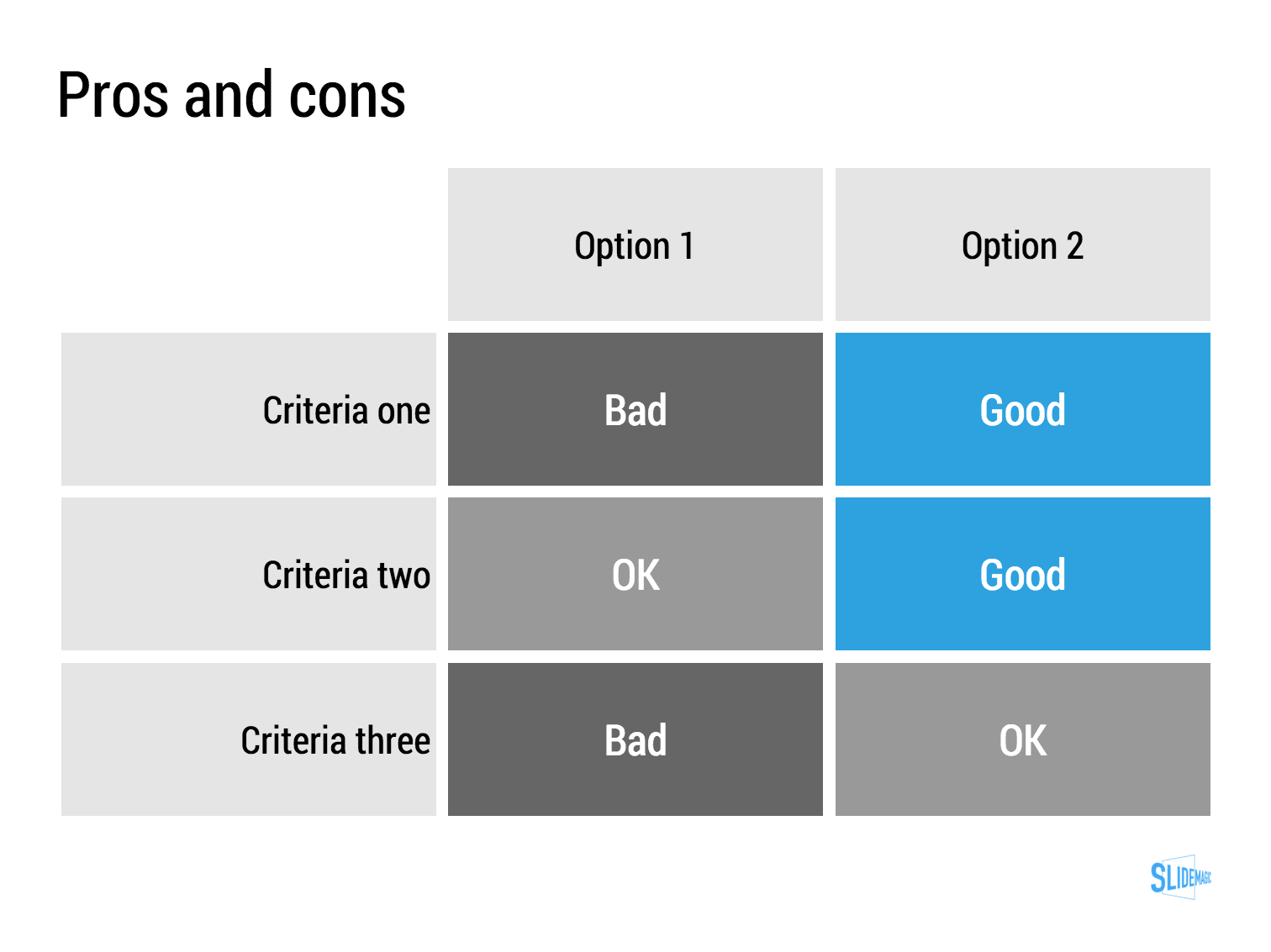
My answer is: a simple table, like this one I prepared quickly in my presentation app SlideMagic (you can clone it to your own SlideMagic account in the presentation template file that contains on the slides I have used on this blog).

The difference between a good pro/con slide and a bad one is not the design in itself, it is how your present the argument. A presentation slide is a tool to get a decision, it is not a laundry list of pros and cons that you evaluated in your analysis. Put your analysis aside, and design from a blank sheet of paper:

  • Group similar arguments together, if an argument is sort of the same, combine them
  • Sort the rows in the table in such a way that things visually line up. For example you start with rows where both options are "good" (all blues), then do the "OK/good"s, then the "OK/OK"s. etc.
  • Isolated and focus those arguments that are going to drive the decision and/or are controversial. "Option 1 is cheaper, option 2 is faster but the what will make the difference is whether we think [criterion 3] is important.
  • Cut words rigorously until you have a page that is still meaningful but does not look cluttered.

SlideMagic: a platform for magical presentations. Free student plan available. LEARN MORE
The impatient audience

The impatient audience

When I am reading I switch in different modes:

  • Losing yourself in a novel and forgetting the time
  • Digging through an article to find the acquisition price that was paid for a company
  • After having failed to resist the click bait title, looking for the answer to the question it raised
  • Absorbing every background aspect of the making of a certain music album

"Newspaper" journalists often get this wrong. They think they are writing for a person sipping a glass of wine and sitting in front of a burning wood fire, while most often they are not.

Hardly any business presentation is digested in the lounge chair. The audience:

  • Has no time
  • Is constantly distracted by calls, emails, messages
  • Thinks that they know it all already and tries to put your idea in a box that is familiar
  • Is clicking down and clicking down and wondering when they get to the point already

The captive TED Talk audience is in the lounge chair sipping wine. The venture capitalist is scrolling down your slides on her mobile while wondering whether the elevator button "1" or "0" will get you to the lobby.

BTW: Happy 2016 to everyone!


Art: Edouard Manet, Young Woman Reclining in Spanish Costume, 1862-1863

SlideMagic: a platform for magical presentations. Free student plan available. LEARN MORE

Know the risks

Know the risks

In yesterday's post VC Fred Wilson gave another interesting peek inside the brain of an investor:

  • Investors are in the business of taking calculated risks
  • Any investment has risks attached to it, you just need to manage/mitigate them
  • And here is the key point: an entrepreneur who does not see (or does not want to talk about) the risks is an absolute no-go.

Investors are potential future Board Members looking for CEOs they can work with. Act like one.


Image: Painting by Tigran Tsitoghdzyan

SlideMagic: a platform for magical presentations. Free student plan available. LEARN MORE
Your audience has heard it before

Your audience has heard it before

You are only aware of your own sales or investor pitch. Your audience (investors, clients) sit through dozens of them. After 10 sales or investor pitches in a certain industry, they probably understood the key industry trends, and in their heads they are wondering how you are different from the others.

Have the "101" slides ready, but the body language of your audience should tell you whether you are the first presentation they are watching, or number 12.


Image by Malcolm Carlow

SlideMagic: a platform for magical presentations. Free student plan available. LEARN MORE

How to write a good cover email pitch

How to write a good cover email pitch

Cover emails that introduce a presentation are very important. It is the first thing the recipients sees. And given that more and more emails are read on smartphones that are not very good at handling attachments (still), they have become more important.

Here  are 2 poor cover emails:

  • One that says too little: "Please see the attached business plan"
  • One that says too much: the whole pitch cramped into the body of the email with out the visual support of your slides

The enemies we are fighting: getting ignored (the email is not opened), or getting deleted/archived before the whole message has had a chance to come across.

What can you do better?

  1. A good subject line. If it is a cold email, use the full space you have, almost like a Tweet. Good subject lines intrigue, they don't have to  tell the whole story. Good subject lines tell more or less what you want.
  2. Write who you are, how you got to the recipient, what you do (no intriguing here, super factual and super short, let the recipient put you in a box) and say what you want. 
  3. The body of the email is all about intriguing. Unlike when you are in the room where you can stand in front of the door to prevent people from leaving, here, it is you versus the mouse click:
  • Think very hard about what the intriguing aspects of your story are. Every pitch has usually only one, or two. (A completely counter intuitive approach to solve an issue, a truly unique team, etc.)
  • Forget about the classical business plan story line, you need to get these intriguing aspects across as soon as possible, BUT think of a story flow that allows you to do that. In most cases you need to educate the recipient a bit before you can deliver the key surprise. 
  • As you add more content, think hard: does this line increase my chance of a response (pick up the phone, click the attachment, write a reply)? Sometimes the best is to keep things short. Cut buzzwords, cliches, any baggage.
  • Look at the typography, line breaks, paragraph lengths. Do the right things pop out?

In short, cover letters:

  • Say who you are, what you do, and what you want
  • Intrigue, even if that means to leaving out a lot of content, and/or mixing up the story flow.

SlideMagic: a platform for magical presentations. Free student plan available. LEARN MORE
A typical startup pitch story line

A typical startup pitch story line

I noticed that many of the pitches I have been designing recently follow this kind of narrative:

  • [Something] has been going on for ages
  • It is hard to understand that with all technological progress we still have to do [this], [this] way
  • Well, there is a good reason for, because until now it was not possible to get [this] right
  • Enter [company] that for the first time can offer [this] and [that] at the same time
  • This is not as easy as it sounds: for example look how hard it is to do [this]
  • It is not hard to see why in a couple of years, everyone who used [this] will now be using [that]

After this, the more standard "about" section follows with information about the company, the product economics, financials, team, etc. etc.


Art: Vincenzo Campi, The Fruit Seller, 1580

SlideMagic: a platform for magical presentations. Free student plan available. LEARN MORE

You are wasting time on PowerPoint

You are wasting time on PowerPoint

The majority of business presentations are not TED Talks, are not major product launches, are not State of the Unions. Corporations automate and simplify many processes: accounting, HR, planning. These non-critical "presentations" are the glue/oil on which corporate middle management runs. Decision making and deal making is done around endless iterations of confusing and boring PowerPoint decks because we do not have time (see the irony) or are not in the same place to communicate directly and clearly and sort things out on the spot. Asking for another version of a PowerPoint deck and a meeting next week is the most convenient form of procrastination.

My presentation app SlideMagic (sign up to try it) has been created to kill this inefficiency and give everyone a simple tool to create good enough, decently designed business documents that can be created in an instant, freeing up time to do more interesting and important things.

Here are 2 types of internal corporate documents and reasons why you spend too much time creating them, and the audience is spending too much time decoding them.

  • Big decision trade offs. The audience wants to understand what the options are and a clear set of pros and cons (preferably quantified and comparable) to make a decision. And, yes, they want to know which option you prefer. You write endless pages with market context, general trends, project team history, description of the work, without getting to the point.
  • M&A deals. Consultants produce endless amount of pages with company backgrounds, company history, description of assets. While the buy side is out to make a DCF valuation model. It needs to understand what the basic business units are, how the economics of the business work, and how to think about forecasting things in the future. Maybe you should not write down a generic business description, but instead create a document that spoon feeds assumptions for a valuation model.

SlideMagic: a platform for magical presentations. Free student plan available. LEARN MORE

Two related product stories

Two related product stories

Sometimes, your company has 2 products with similar, but different stories. Pitch the products in full detail sequentially duplicates some of the common parts of the story (and bores the audience) A generic pitch followed by example 1 and example 2 makes the product pitches too weak.

A possible solution that I recently applied to a medical technology startup:

  • Layout the basic idea behind the innovation that is shared between the products, not necessarily as a pitch, but more to educate the audience
  • Set up the company as a combination of 2 parts
  • Do a full pitch for product 1 (without repeating the basic concept that was explained in the introduction)
  • Do a slightly shorter pitch for product 2, just highlighting the differences in the technology for product 2 compared to product 1.

Art: John Everett Millais: Twins, Kate Hoare and Grace Hoare, 1876

SlideMagic: a platform for magical presentations. Free student plan available. LEARN MORE

Should you add financial projections in a startup pitch presentation?

Should you add financial projections in a startup pitch presentation?

Everyone knows that you made them up, nobody knows the future, all startup pitches predict hundreds of millions of revenues at some stage in the future. Why bother putting these shaky financials in?

Yes, there is no point in including your highly precise 10 year financial forecast model, exactly for these reasons, but, there is still a place for financials in your pitch. Here is what I usually do.

  • A reasonably detailed and precise "forecast" of the short term financials. In most startups, this usually involves only costs. And unlike the revenues, you can be pretty certain about where you are going to spend that investment on in the near future. The benefit: 1) investors know where their money goes, and 2) investors see that they are talking to a CEO who seems to know what she is doing, has things organised.
  • A very high level annual revenue outlook for the next 5 years. Nobody will pay much attention to this hockey stick chart.
  • But - and this is the useful bit - add another slide that shows in a few simple calculations what you would have to believe in order for that year 5 revenue and profit number to be true. The best is a multiplication of 5-10 simple numbers: # countries, people / country, market share, price / user, gross margin, fixed $ million cost. You teach the investor how your business model works (what factors are important) and provide a way to evaluate whether your forecast is highly optimistic, or totally insane. The underlying Excel model can still be very detailed (it should be), but the 5-10 numbers should be very simple. I have had design projects where the company went back and revisit the Excel model because of an inconsistency in these high level numbers. 

Art: Albert Anker, The Fortune Teller, 1880

SlideMagic: a platform for magical presentations. Free student plan available. LEARN MORE
Do you need the "Thank you" slide as the last page?

Do you need the "Thank you" slide as the last page?

Here in Israel everyone puts a "Thank you" slide as the last page of the presenting. Almost to thank the audience as it is impossible for the voice to be heard during the roaring applause. People ask me, should you use it?

It depends how.

The huge "thank you" with a big cheesy stock image of applause is definitely not the way to go. A dense page the repeats/summarises the entire presentation in detail also won't work.

You want to end any presentation with a strong upbeat message. The worst ending is, "well, this is it, we are running out of time, and I just managed to stay in my slot". It is better to put up a slide that puts in some call to action: "Sign up now to change the world!" or something.

For investor presentations, this is a bit harder. "Wire to this bank account" is pushing it too much. In these cases I actually put up a slide with a small/subtle "Thank you" (for your attention) title and the contact details of the person in charge of fund raising at the bottom. 

As a visual I tend to use the a memorable photo, graph, concept from the presentation that works as a memory shortcut to my entire story. 


"FolkRetabloRoomChalma" by Thelmadatter - Own work. Licensed under CC BY-SA 3.0 via Commons.

SlideMagic: a platform for magical presentations. Free student plan available. LEARN MORE

People catch up quickly

People catch up quickly

In many investor presentations, startups want to educate the audience first on a big trend that is happening. But, especially in consumer/internet, people catch up really quickly and you will loose the audience attention and your credibility of you spend time and slides on explaining things that everyone understands. 

Some examples I can remember (some of them from my time at McKinsey):

  • Home pages
  • Sticky eye balls
  • Portals
  • Market places
  • Social networks
  • Social media
  • Viral videos
  • Location-based services
  • Online video and the growth of bandwidth
  • Sharing economy

Smart VCs read the same blogs as you.


Art: Student at his desk, Pieter Codde, 1630

SlideMagic: a platform for magical presentations. Free student plan available. LEARN MORE

"This is how we always start"

"This is how we always start"

Your company changes rapidly, your pitch stays the same. I meet many company CEOs that started their company years ago, often at some startup pitch event. The story opening then was about them, in the absence of a real company. Years later, that same intro can often still be found in the presentation, just with an update of the sales and employee numbers.

Your pitch presentation should be one step ahead of your company, not one step behind.


Art: Lautrec, Woman at her toilette, 1889

SlideMagic: a platform for magical presentations. Free student plan available. LEARN MORE

Finding the bottleneck

Finding the bottleneck

If you are struggling to get traction with your investor presentation, it is worthwhile to try to find out where the bottleneck is:

  • Do investors understand what I am trying to do?
  • Do investors understand that this is a big problem/opportunity?
  • Do investors understand that someone can make a big business out of this?
  • Do investors understand that I am the person who can make a big business out of this?

These are slightly different questions than the ideas entrepreneurs often have:

  • My slides do not look "slick" or professional enough, let's add some colour
  • The story flow is not completely right, let's talk about the market earlier
  • We have not put in aggressive enough financial forecasts, let's bump it up to $100m
  • We did not put in that Gartner total market number for 2016
  • We are not mentioning the right buzzwords, let's add a few
  • The deck is too long, let's cut it down to 5 slides by combining pages
  • We should use Keynote or Prezi, PowerPoint is stale
  • We should invest in a video clip
  • The deck needs more animated slides
  • AirBNB raised a lot of money, let's copy their pitch deck

SlideMagic: a platform for magical presentations. Free student plan available. LEARN MORE

Filter your VCs

Filter your VCs

Fred Wilson discusses a blog post by the CEO of eShares about his fund raising experience. Let's throw in my experience as an investor presentation designer (both for startups and VC/PE funds themselves).

  • A decision in 5 minutes. Yes, most VCs will make a decision whether an investment merits deeper due diligence in 5 minutes.
    • This might actually be good news for startups. If you have a good deck, you can get to a decision without travel-meeting-travel. 
    • It proves again that a 5 minute pitch is not 5 minute filled with fluffy buzzwords.
    • If the feedback from a phone call is "no", it is probably highly unlikely that banging the VC on the head for 60 minutes in a meeting or coffee chat is going to change her mind. Better spend that energy on another investor. If you ask why, and she says "the market size" politely, coming back with 50 slides about the market size is not going to change her mind. Market size is probably not the real reason
    • That coffee chat, is actually a meeting that is further in the due diligence process: you passed the first stage (you seem to have an investable idea), now things have moved on to checking you out as a person/CEO. There is no better way to do that then a brief meeting. Even if you just talked about the weather, the investor will make up her mind about you.
  • Risk-related questions are a sign that you are moving in the right direction. An interested investor is trying to figure why she should not invest in you, much better than a bored investor trying to fill the 30 minutes with asking questions why she should invest.
  • Combine the above points and you can see the implication for your pitch deck: very focused, highly emotional, visual, charts to get the big idea across in a few minutes, and actually more charts for those risk-related questions, to take the obvious questions out of the investor who has bought into the basic idea.
  • Investors are increasingly specialised and have a specific mental model against which they evaluate opportunities. If your business does not fit a specific model/investor profile, find a different one rather than forcing let's say a semiconductor business into a CAC/LTV/churn SAAS spreadsheet
  • One more point about the 5 minute pitch. I had client briefing meetings where I only go the point of the pitch after 45 minutes of discussion. I tried from the left, from the right, tried again, thought it was just me who was to ignorant not to see something, until finally the coin drops. Be very perceptive when someone in front of you who is willing to grant you the 45 minutes, this might just save your 5 minute pitch.

Reading body language is important skill that can save you a lot of time and wasted effort.


Art: Company of ladies watching stereoscopic photographs, painting by Jacob Spoel, before 1868

SlideMagic: a platform for magical presentations. Free student plan available. LEARN MORE

The press release is dead

The press release is dead

TechCrunch blogger Mike Butcher wrote an interesting blog post about how to pitch to tech journalists/bloggers. It is well worth a read (below are his slides that convey a similar message from 2012).

Like VCs/investors, tech journalists are overloaded with inbound pitches. There are similarities in the way you should pitch them:

  • Get straight to the point, cut the fluff/small talk
  • Give more or less the full info the 1st time around, no "can I send you some more information"
  • Be concise and clear what your project does and why it is great

There are differences though with investors:

  • Exclusivity (breaking a story first) is really important to journalists, so blasting your news out to 100 people is not going to make it more attractive
  • Journalists really want something to be news (dah), something that the world has never seen/heard before, investors are looking for the big returns, even if it is an old idea that is recycled
  • Big $ fundraising is seen as validation by journalists, investors probably care less (at least the good ones who can spot a rough diamond before everyone else)
  • Journalists might not have the in-depth technical knowledge as a highly specialised VC (an early stage medical device investor), and like to compare/contrast companies and technologies to the ones they know (competitors).
  • He loves plain text and hates PDFs/attachments. This partial because of practical reasons (mobile devices, copying quotes), but also - I suspect - the journalists are actually used to digesting written/verbal communication and less used to digesting visual slides (hypothesis).
  • The world of tech journalism is changing. In the early days TechCrunch used to be all about startup discovery, now there are increasingly other news sources that plays this role (Product Hunt for example). Mike says he is increasingly interested in deeper, background stories. So putting your pitch into the context of an overall trend that is happening might make it more interesting to publish.

Two lessons here. One: the wordy, fluffy, 1-pager/press release is not going to help you here. Two: pitching to journalists is different from pitching to investors.


Art: Edouard Manet: Music in the Tuileries, 1862

SlideMagic: a platform for magical presentations. Free student plan available. LEARN MORE

I am going to force feed my Executive Summary on you

I am going to force feed my Executive Summary on you

People often ask me what an appropriate summary presentation is to send a head of the actual presentation, the dreaded "Executive Summary".

Executive summaries and web landing pages have similar objectives. Keep the user hooked long enough to transfer the idea/messages and get her to do something at the end (click "BUY", or reply to the email and set up a meeting).

In web design, people have learned a lot. Use lots of white space, attractive images, links with inviting text that scream "click me", cut out boring non-essential information and put that on pages for people who want to look for it.

The Executive Summary though is still in the 1990s:

  • We expect tat our story is so boring that we need to drag the reader through it as long as we can
  • The solution: cut the amount of pages (maximum 2), anyone can read just 2 pages right?
  • Whoa, how do fit all this information on there: reduce font size
  • We need a big bold vision statement upfront (1 paragraph at least), a big bold vision statement really encourages the reader to keep on reading. Maybe there will be more big bold statements on page 2? Good stuff!
  • The it is important to link our idea to all the latest buzzwords, readers love to hear more of the things they read on the latest tech blogs. Even if it is vaguely related to your idea, put them all in there. Wow, this Executive Summary is all about these great trends? I have to read on!
  • After rereading the Executive Summary, we find that it sort falls out of the blue. We need to tie it into the big things that are happening in society. Mobile phone penetration is huge right now. Social media is changing the way we consume content. (This is especially true for younger people). Gartner and IDC have some good stats and quotes on this, let's add them. The reader must think: I want to read more about this!
  • The broader market (TAM) is just absolutely big. We are the only company in this space but the market will grow from $15b (2011 data) to $32.67b in 2014. This size market? These guys have discovered something that I completely missed, must read on.
  • Our technology is absolutely amazing. Let's start with the bottom architecture layer, and build it right up step by step. The "secret sauce" that makes us so scalable and flexible
  •  We are 1.5 pages in, time to introduce the idea. 
  • Oops, what about the team? Five bullets with CV summaries (don't forget the undergraduate degrees, and our hobbies).
  • Squeeze the margins a bit, it just fits.
  • Now copy paste selective paragraphs to put in the cover letter of the email.

This is clearly going to get someone excited (not). Think about your Executive Summary as a landing page that competes for the reader's attention. Make it visual. Make it presentation slides instead of text. Introduce what is you do early. Intrigue her on every page so she clicks through to the next one.

Force feeding Executive Summaries have not resulted in a lot of follow up meetings.


Art: Eduardo Zamacois y Zabala (circa 1841-1871), Taming the Donkey1868

SlideMagic: a platform for magical presentations. Free student plan available. LEARN MORE