Viewing entries in
Investor presentation

Investor versus client positioning

Investor versus client positioning

In most big B2B enterprise sales dialogues the client understands the market, knows the key players out there, knows the issues she is trying to solve. They don't care about margins, market sizes.

In most investor pitches, the potential investor knows the broad market segments that sound similar to the one you are operating in, knows how big they are roughly, knows major competitors. They are less interested in specific feature comparisons.

Presenting your differentiation, what makes you special, is different to each of these audiences.


Image from WikiPedia

SlideMagic: a platform for magical presentations. Free student plan available. LEARN MORE
Which clients raise money?

Which clients raise money?

I see dozens and dozens of technology startups and yesterday I sat back and jotted down the similarities between my clients that manage to raise money. Disclaimer: it is not scientific, it is not conclusive, and in many cases I actually do not get updated on whether the fund raising round was successful or not.

Here are some similarities:

  • More than one exceptional team member, the company is not just carried by one strong CEO
  • Straight to the point discussions during the briefing meeting, no buzz words, no vague marketing frameworks, no empty discussions about flow in the absense of substance
  • A positive and happy working environment. Supportive feedback, respecting people's time instead of negative comments all the time, insisting on unreasonable deadlines, making people wait a long time, calling in person meetings to communicate something that could have been done in a phone call. These are places you want to do your best
  • People are open to reposition, change things that are pretty fundamental to the company. 
  • Taking advice and input form people the right way. Some people get listened to, others ignored.
  • A realistic awareness of strengths and weaknesses

OK, you need to have a good business concept. But looking back at the above points, these are companies that designers like to work with (and presumably investors want to work with them as well). There is a contagious, positive energy among them.

SlideMagic: a platform for magical presentations. Free student plan available. LEARN MORE
Where to put the team slide in the pitch deck?

Where to put the team slide in the pitch deck?

Venture capitalist Mark Suster posted a quick video about this issue.

His advice:

  1. What you do (he is right, some pitches are vague about this), if you can, even without slides to make direct eye contact with the audience and establish rapport.
  2. The exec bio, to establish credibility, why you are the right person to pursue this opportunity
  3. The body of the presentation

He has a point. BUT, I would keep that bio slide super short, maybe limit it to the CEO and/or people who are presenting in the room and put the dense, detailed CV information in a slide later in the back. Grinding through lots of CVs of everyone on the team can break the momentum of the presentation (unless everyone on your team is a unique rockstar). Also not every startup has that rock star team (which probably gets you a minus from Mark anyway).

A final note, if you are presenting to Mark, there is no question, put that full bio slide on page 2. You should research every person you pitch to, and this is how he likes to see things, so that's what you do.

SlideMagic: a platform for magical presentations. Free student plan available. LEARN MORE
Problems, problems, problems, solutions, solutions, solutions

Problems, problems, problems, solutions, solutions, solutions

Most product pitches go something like this:

  • Existing solutions have this problem
  • Existing solutions have this problem
  • Existing solutions have this problem
  • Existing solutions have this problem
  • Existing solutions have this problem
  • Our solution does not have this problem
  • Our solution does not have this problem
  • Our solution does not have this problem
  • Our solution does not have this problem
  • Our solution does not have this problem

The story gets repeated, which makes the whole things boring. A better option is to elaborate on the problems, but then keep the solution section relatively short. You can even show a grid of small screen shots of all your "problem" slides, with tick marks over each one of them.

SlideMagic: a platform for magical presentations. Free student plan available. LEARN MORE
Example startup pitches

Example startup pitches

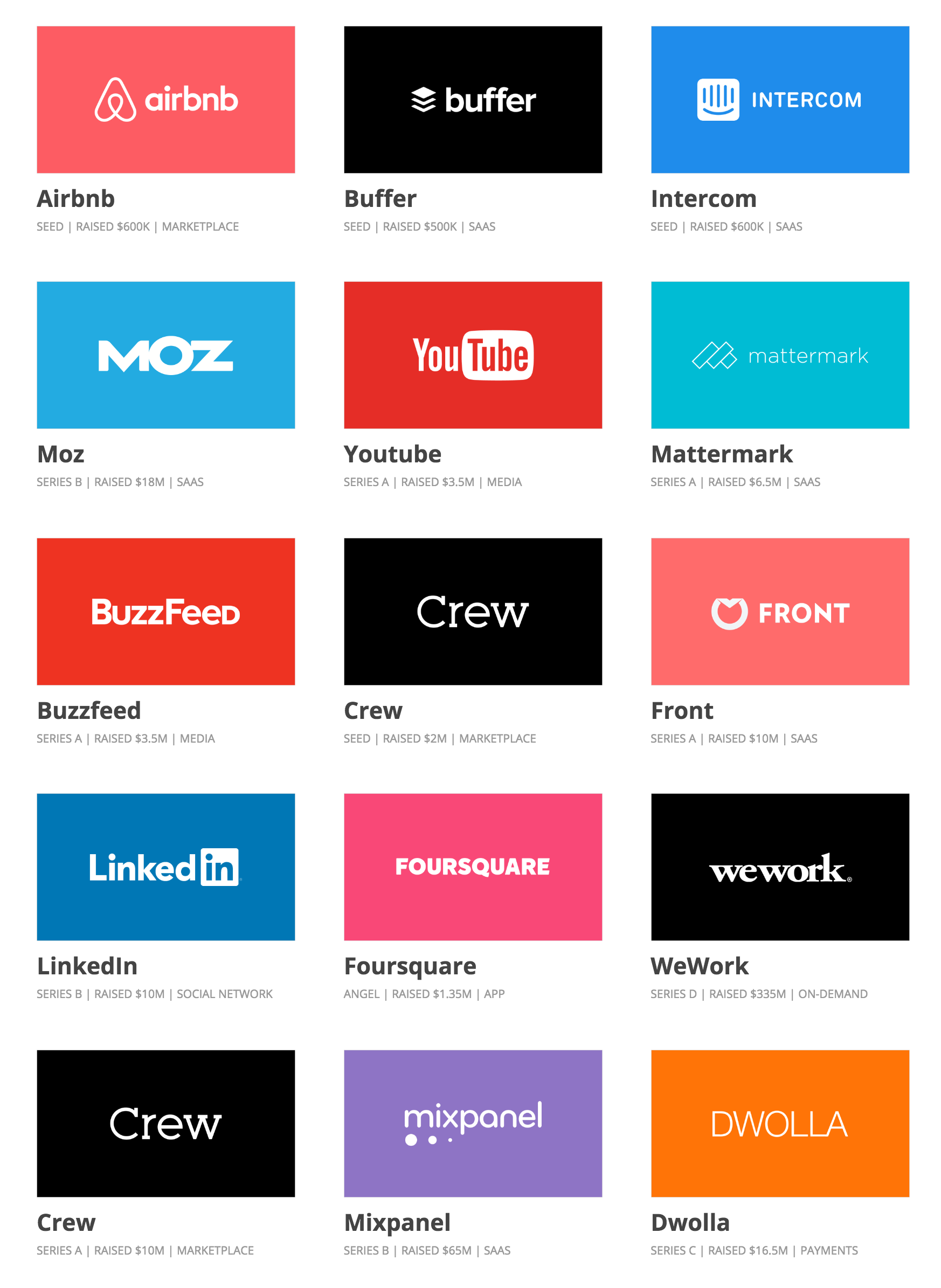
Here is a nice collection of early-stage startup pitch decks that managed to raise money successfully.

There are some common concepts in all of them:

  • Most importantly, they are actually great ideas. LinkedIn, YouTube, AirBNB now look like totally obvious concepts, but back when they started out they were not.
  • They explain clearly what the company/product actually does, often via a demo of screen shots. Many startups omit this important part of your pitch (surprisingly).
  • Often, there is a very powerful traction slide inside. If you have grown your business from nothing to millions of dollars in 6 months, investors will pay attention, and forgive you if the rest of the slides in the pitch deck are not that good.
  • All these decks are email friendly, you get the idea without the need for a presenter to explain it to you. (That is now actually the main type of presentation I design for my clients) 

SlideMagic: a platform for magical presentations. Free student plan available. LEARN MORE
Full circle

Full circle

Every pitch starts with an informal, but often very good, story/conversation. Then we start to complicate things with slides, templates, storylines, structures until we get to some slide deck. Then, it is often useful to step back to the very fundamental investor questions:

  1. What is it they are trying to do? (Often not clear in a presentation)
  2. Will anyone want to use it? (Rational logic, emotional gut feel)
  3. Can you make money from it? (There are many good ideas that do not deliver a profit)
  4. Can this team pull it of? (Probably most important question)
  5. (Can I construct a good deal given valuation, cap tables, Board seats, etc.)

SlideMagic: a platform for magical presentations. Free student plan available. LEARN MORE
Raising money with 5 slides

Raising money with 5 slides

It happens. Some startups can create one slide that shows a line from 0 to 100 million users or $500m revenues in 1 year. Some startups can show a slide with clinical data proving they have the cure for cancer.  If you are not one of them, don't listen to pitch advice by these startups and have some more backup information.

SlideMagic: a platform for magical presentations. Free student plan available. LEARN MORE
Overcompensating

Overcompensating

Each pitch has a weak spot to overcome. How to deal with it in your presentation?

  • You can ignore it, sweep it under the carpet. You will have had a very pleasant meeting, but you are unlikely to land the deal
  • You can mention it, and support a very shallow case why it is not an issue. (Vague analyst quote)
  • Overcompensating, give 15 different possible analysis that triangulate to the most likely market size number. This just might scare your audience. If 50% of you time/charts are about this issue, this must really be a big deal.

Better: admit the issue is there (you scored some realism points in the process). Give an honest defence, but don't burry the audience in analysis (yet). Wait with that for the 2nd meeting which might have that issue as its sole agenda point.

SlideMagic: a platform for magical presentations. Free student plan available. LEARN MORE
The one big question

The one big question

There are a few levels you can go through as a startup with a VC:

  1. Basic fit. "Sorry, your mobile gaming app is not really a good fit with our biotech focus"
  2. Does the idea make some sort of sense. If the VC thinks not, you are likely to get very generic feedback from the VC, "too early for us". There are simply too many things wrong with it that the VC does not even get started to get into it.
  3. No obvious hygiene issues. Difficult cap table. Unfriendly co-investors. Questionable IP. Lots and lots of follow-on investment required. VCs will usually give straight feedback, unless the issue is for example a really toxic CEO they don't like, at which point they might say "too early for us".
  4. Then there are the real, gentle difficult questions. Is there really a market for this? Will the regulator agree? The VC really wants the answer to these to be "yes", but needs backup to convince her partners.

Once you have reached stage 4, the VC will tell you what the issue is. And this is the main issue that needs to be cleared. All the other slides in your presentation have been bought into already. You can give a great presentation, but if you did not manage to convince the investor of the Big Question, then you are not going to land the investment. Trying to hide the elephant in the room is not an option.

The interests of the entrepreneur and the investor are aligned. You want the answer to be "yes". A good VC might even hand over data sources, give access to people to talk to, to help you make the point. Hopefully it is the start of a long cooperation together.

SlideMagic: a platform for magical presentations. Free student plan available. LEARN MORE
Words and number consistency

Words and number consistency

It is impossible to make a correct 5 year business forecast in an investor pitch. But your financial projection is not really a forecast, a prediction of the future, it is a picture made out of numbers. "If our company will be successful, this is what it could look like".

Mistake number one is to make the projection ultra precise with 5 digits after the comma. It is just a guess, so a year 5 revenue number of $99,234,318 is not more credible than ~$100m.

But oversimplifying is not right either. The fact that you are for sure going to be wrong does not mean that you simply take 1% of a big market number to get to the year 5 scenario.

The trick is to make the words/visuals in your presentation consistent with your financial model. You are going to sell to millions of individual customers, drive the model that way. You rely on 5 big telco operators, put it in. SAAS company with recurring revenues? Model it. One-off perpetual licenses, use it as the basis of your model.

Teaching investors how the business works is more important than getting the point estimate right.

SlideMagic: a platform for magical presentations. Free student plan available. LEARN MORE
Great and difficult starting points

Great and difficult starting points

There are a number of starting points for my presentation design projects that almost always result in great presentations:

  • The enthusiastic CEO with a strong story who is all over the place with bullet point charts, skipping/jumping left, right, and centre
  • The scientist with a strong idea that is buried in dozens of unreadable data charts
  • The engineer with a great product, presented in a presentation that looks like a deck used to present the result of a school end of year craft project
  • The Fortune 500 investor relations manager with a quarterly results deck in a standard PowerPoint 2007 template that is more of a general company introduction than a razor sharp story updating investors about the key business drivers in the last quarter.

Difficult starting points:

  • A confident CEO, with a visual deck (lots of big pictures) that spends too much time on explaining a relatively obvious point, ignoring the "elephant in the room" practical questions that investors might have (yes, we get the idea, but how can you build this realistically in 3 months).
  • A scientist who is so used to her existing slides that her pitch would not change much, even when equipped with the world's most beautiful slide deck.
  • An inventor with a great idea, but no team, no plan, no technical approach

Never a dull moment in my profession!


Image from WikiPedia

SlideMagic: a platform for magical presentations. Free student plan available. LEARN MORE
Cold emails

Cold emails

Now that I am a CEO of an Internet startup (www.slidemagic.com) my email address is slowly spreading in the databases of app developers, PR people, recruiters, marketing consultants, SEO firms etc. Although not in the same quantities, I start getting the type of pitch emails that venture capitalists, journalists, bloggers must be getting.

Most of these emails actually get through spam and other gmail filters. In some way or another, the recipient will look at them. Especially now that mobile devices enable you to kill dead time with gracing through your email field.

The majority of these emails get totally ignored. First of all because of basic hygiene that has been discussed in thousands of blog posts before: generic subject line, generic "hello there" greetings, spelling mistakes in names, etc.

But there is a bigger thing that turns me of: the way they are written.

  • Too generic. The sender has not bothered to check out what my app does, what stage my company is in, what sort of services I might need. Instead, it could have been highly personal and relevant (what features my app lacks, which LinkedIn contacts we have in common, etc.)
  • Too complete. The email tries to do a full pitch of the company and its services. As a results things sound bland. You will never land a contract with a cold email. Better is to write something very short, but intriguing. Something that does not cover everything you want to offer me, but makes me hit reply to find out more.
  • Specific links to specific information are missing. A portfolio to look at, apps that you designed, not just the root of your web site.

A pitch to me good be. Hey Jan, we had a look at your app SlideMagic.com and you have set yourself quite a challenge by taking on PowerPoint. Your app requires a lot of client-side Java script, and that is our specialty. Have a look at [app], [app], and [app], examples of client work we did. We have a few ideas on how to improve your app, do you want to discuss?

When pitching investors you can do something similar. Hello VC. I read your blog post of last week in which you expressed interest in drones. We are the first company that has a solution for that issue. We can explain later in more detail, but the crux of the idea is that we combine [z] and [u] to do [d]. As you know, nobody has made that happen. Do you want to find out more?


Art: Hendrick Avercamp, on the ice, 1610

SlideMagic: a platform for magical presentations. Free student plan available. LEARN MORE
"Let me explain it to you again"

"Let me explain it to you again"

A good pitch of an idea provokes feedback of the audience. If people are just sitting there, watching politely, smiling, and walking out of the room, you are unlikely to land an investment.

When you get feedback (praise, criticism, difficult questions), it is important to realise who it is coming from. Do people care about you, want to help you? Do you they have the right background?

  1. Your mother: she totally admires everything you do, but in most cases might not have deep knowledge of what it is you are actually doing
  2. An industry incumbent who cannot see any change happening having worked in the field for 30 years
  3. A (potential) competitor who is jealous
  4. A friendly investor who does not understand the field
  5. A friendly investor who does understand the field
  6. An interested investor who is negotiating with you
  7. A friend of a friend of a friend who is an expert in the field but who was arm twisted in listening to you to return a favour but does not really have time for this and/or you
  8. Etc.

Pay special attention to people who know what they are talking about, or people that are an example of a type of audience you are going to pitch to a lot (confident, successful investors, that might not fully understand the ins and outs of your market). Group one helps you bullet proof the content, group 2 helps you bullet proof the presentation.

What sort of feedback do you get:

  • Generic praise
  • Generic suggestions to change your presentation (summarise everything early on, re-order these 2 slides, cut the amount of charts to max 10, the 10/20/30 rule)
  • An easy question with 3 buzzwords in them
  • A difficult question that you know is a difficult question but you don't have the answer to
  • A difficult question that you thought you explained well in the presentation
  • A difficult question that you heard for the first time

Some feedback can be ignored (the audience is not qualified, the feedback is generic, polite small talk). Some feedback is an "attack" aimed at hurting you (a competitor who feels threatened, an investor who wants to push the valuation down). But most feedback probably is from people who try to be helpful or really don't understand something.

Faced with criticism, humans tend to go in defence mode. We hardly let the questioner finish her question. We don't read body language. We fire away our ammunition. Repeat the same answer, the same slide one more time, forgetting that it failed to convince the audience the first time. Point at a huge Excel model (cell C27) that has 5000 lines of code that proves that you are right. Do what politicians do: divert the attention to another issue.

The most useful feedback might a small unexpected question, from someone who has no reason to help you, is not negotiating with you, has no time for this meeting, and is a huge expert in the field. Read the body language. Ask the person to elaborate on the question. Ask why she thinks it is an issue, what experience does she base it on.

Other good candidates for feedback are potential customers or users. Hold your fire, and listen carefully.

Sometimes it is useful to ask a lot of questions to the people who ask you questions.

 

SlideMagic: a platform for magical presentations. Free student plan available. LEARN MORE
Fixing investor pitches

Fixing investor pitches

Each investor pitch project is different, each requiring upgrades in specific areas. Here is a list of what I typically encounter. Usually a client did a few right, but needs help in a few others.

  • Too PowerPoint: all the standard colours, fonts, etc.
  • 1990: clip arty or 2005: cheesy stock images
  • Too TED: so minimalist that it is impossible to understand what the company is actually doing
  • Missing business case (revenue model, etc)
  • Grand opening full of obvious facts that takes forever before turning attention to the company itself
  • The company does not explain why what they do is so hard, clever, original
  • Bullet point overload (but I see less and less of this)
  • Not addressing the elephant in the room, the obvious big question that is screaming out to be answered
  • Not enough "meat" to show that there is real science, technology, substance here
  • Visual analogies are too complicated to understand
  • Excel data dumps straight into PowerPoint
  • Too many benefits, as a result the audience perceives: "no benefit"
  • Unfocused feature expansion list: "and we will this, and we will do this, and we will do this"
  • Too much design: icons, cute fonts, Adobe Illustrator shapes mixed with PowerPoint 

SlideMagic: a platform for magical presentations. Free student plan available. LEARN MORE
Dressing down the story

Dressing down the story

In many pitch presentations, I work hard to lift a story to its true potential. Show the bigger picture, put things in a historical context of where humanity is going, visualise the - dreaded word - vision.

In some presentations the opposite is required. The audience will get the dream, but will wonder whether any of this stuff is actually real, or happening within the next 2 years or so, because it all sounds too good to be true, or too expensive, or too science fiction.

Thinking about your audience before you start designing is a cliche from communication trainings. Maybe make it a bit more practical and try to imagine what stereotype people would assign to you after they see/hear you speak for 1 minute.


Image from WikiPedia

SlideMagic: a platform for magical presentations. Free student plan available. LEARN MORE
Beyond the presentation

Beyond the presentation

The investor or sales presentation is not the only thing your audience will check out:

  • Do you have a proper email address or are you still using your gmail?
  • Is your LinkedIn profile consistent with the claims in the presentation?
  • Does your web site have the latest company logo and is free from cheesy stock photos?

If you do not have much to share with the public yet on your web site (you don't have any customers yet, your product is not finished, etc.) it is often better to keep things brief (Coming soon, we are working on [...]) in a really crips and professional look, than padding the page with marketing buzzwords and claiming that your are a Fortune500-like company with 20 offices, delivering flexible and scalable ROI to 100s of clients around the world.


Image from WikiPedia

SlideMagic: a platform for magical presentations. Free student plan available. LEARN MORE
Talking is the best briefing

Talking is the best briefing

A story line skeleton is hardly ever the best briefing for a presentation. It is useful for an analyst who has the fill in the missing pieces of data, not to convey a powerful sales or investor message.

The better approach is to set back and talk things over, that's when big ideas come out.


Image from WikiPedia

SlideMagic: a platform for magical presentations. Free student plan available. LEARN MORE
Make up the financials?

Make up the financials?

It is impossible to predict the financials of a business that does not exist yet correctly. And therefore, every financial prediction you see in a startup pitch is made up. Is there any point in doing it? I think you should.

Numbers are a powerful way to check your story for consistency. You cannot sell to more than 6b people on earth, if you are tripling an existing market, are all constraints you should think about. If takes more variable cost to make something than the price you charge, something is wrong. If you want to sell to 10 large Fortune 500 customers, but you only have one sales person in the office, something might not be right. If you plan to hire 300 people next year, that means 1 a day, how are you doing so far?

The key is to translate top level numbers to things you can touch. Sales are customers x products per customer x a price they pay for it. Sales costs are sales people. Etc. etc.

People are not be convinced by the $100m sales in year 5 because your spreadsheet says so. They will believe that you are someone who know what she is doing when the logic behind the $100m stacks up.


Art: Victor Dubreuil, Money to Burn, 1893

SlideMagic: a platform for magical presentations. Free student plan available. LEARN MORE
Sales versus investor presentations

Sales versus investor presentations

CEOs are used to doing the company's product sales pitch. When they look for investors or acquirers for their company, it is temping to just press play and do that same sales pitch again. But they can be very different stories.

An investor needs to hear the sales pitch. It makes her believe that the company makes products that people want to buy. Also, it shows that the company CEO is actually good at selling (or not). But investors needs more: strategy, financials, margins, funding requirements, and a more explicit comparison versus the competition than you would put in the sales deck.

Potential acquirers might not be interested at all in the sales pitch. Maybe they are considering to buy the company for a very specific asset they need. (Technology, people, distribution). Acquirers need a very specific, tailored presentation. To make it, you need to put yourself in their shoes and resist the temptation to hit "play" and run the sales pitch.


Image from WikiPedia

SlideMagic: a platform for magical presentations. Free student plan available. LEARN MORE
"It takes too much time to get to the solution"

"It takes too much time to get to the solution"

Clients say they get this feedback after giving a pitch. The initial reaction to this would be:

  • Cut slides from the deck
  • Take the specifics out of your text, make it shorter and more high level
  • Combine multiple slides into one

The danger of this is that you end up with a few slides of highly generic and dense bullet points.  Remember:

  • Slide count does not equal time spent presenting them
  • Smacking someone with the solution in their face instantly takes away the opportunity to lead them by the hand in an interesting story that covers the problem you are trying to solve.
  • The best way to sell the solution is to sell the problem

Here is what I do:

  • Create a super short intro slide that explains the audience what you solve and what you do. So they can stop guessing about the point you are trying to get to.
  • Now, lead people through a sequence of visual slides that highlight the problem, slowing down sufficiently to make sure that the audience "feels" the issue. "Production cost is too high" is too generic. Why is it so expensive, and why could no one do it cheaper until today?
  • Then, present your solution and use the framework of the problem you set up in the previous section to mirror your product against markets that are out there in the market today

Image by David Felstead on Flickr

SlideMagic: a platform for magical presentations. Free student plan available. LEARN MORE