A nice collection of startup pitch deck wisdom by Hiten Shah and Marie Prokopets:


SlideMagic: a platform for magical presentations. Free student plan available.
Fast. Easy. Beautiful.
Viewing entries in
Investor presentation
A nice collection of startup pitch deck wisdom by Hiten Shah and Marie Prokopets:
In between the election news: waterfall charts….
Waterfall charts are a great tool to explain the difference between 2 scenarios. In SlideMagic, they are really easy to create. Below is one I put together quickly with data from Apple’s 2020 Q4 earnings result, and a photo I found using SlideMagic’s built-in Unsplash image search. Notice how I opted for an unusual vertical waterfall, to create more space for the axis labels.
Some people would argue that you could make the chart even clearer by breaking the axes: showing them as ‘5.6’ and ‘4.7’ for example. Yes, it would highlight the deltas better, but in general, I think manipulating axes, well, manipulates the message. The fact that the changes are relatively small to the total is part of the message.
I reshuffled the rows a bit to group the decreases and increases. That makes it more clear in one sense, but less clear in another. Your choice.
\How do you go about making such an analysis? I put my numbers in a Google Sheet that you can view yourself.
Enter the data for the 2 comparable quarters in 2 columns. Add the totals as calculations rather than hard-coded numbers to check that you did not make any typos. (The blue cells are the one that I type in, the white ones are calculations).
Create space between the 2 columns
Pull numbers from the input that you consider drivers. You see that I deviated a bit from the way the input was presented:
Divided billions by thousands to make it more readable
I use % gross margin rather than absolute COGS and profit numbers
R&D: absolute number, SGA, % of sales
Recalculate the operating income with just these drivers (line 37), it is crucial that you get this right, double check with the input.
Now start varying your drivers one at a time, and recalculate the operating income in the scenario that just that one variable would have changed (see the green numbers in the spreadsheet).
Finally, check whether the component variations add up to the total variation you need to explain (in this case, I was lucky). If you are not, you need to allocate the non-explained differences to the factors somehow.
It is important to keep in mind that these spreadsheet figures are just spreadsheet figures. The change in product gross margin for example is probably not independent from the change in product mix (fewer phones, more laptops). Also there is a small rounding issue (the rounded vales do not add up to 14.8). I would solve that by chopping the biggest factor (-1.7 to -1.6). It is always distracting when small rounding errors create inconsistent numbers on your slide.
Users of SlideMagic can access the waterfall charts with a search for ‘apple’ in the desktop app.
YCombinator has made library of support material for startup founders available online for free. One of the results for a search on ‘pitch decks’ produces this. Some things to highlight:
“Be excited. Your pitch should not sound memorized. Intonation, cadence, and projecting help a lot”
“Actually explain what you do, and do it quickly”
“Don't be "cute" with your points, be declarative”
“If you make a joke, telegraph it. If you're not sure the joke will land, cut it
“Charts should be easy to understand - make one point with any graphic or chart. Don't make people read charts - they'll stop listening to you.”
“Line graphs are better than bar graphs when showing growth” (Not sure this is the case)
“TAM should be bottom up, not top down” (I.e., not 0.5% of $5billion)
“Coolness and legibility are not orthogonal, they're diametrically opposed”
It is important to understand where these suggestions are coming from: very experienced investors that are focusing on very, very early startups and hence need to sit through many, many, pitches with a huge range in quality (both in terms of pitch quality and company/founder quality). That explains the feedback of make your title readable, don’t use thin fonts, make your slide clear that when I look up from answering an email on my phone, I still know what is going on, don’t be cute, tell what you actually do, etc.
Still, if you are an early stage company looking for funding, this is your audience, better give them what they want. And remember, part of your startup pitch is testing your ability to sell a product to a matching audience. Selling your company to investors, or selling your product to customers, or helping investors sell their stake in your company to another investor in the future, all require similar skills.
Photo by Hunters Race on Unsplash
The most effective introduction to investors is via a referral of a mutual connection. When this mutual connection is ready to put her personal credibility on the line and forward your pitch to an investor, the pitch changes. No small talk, no waffly market backgrounds, and actually, no (or very little) structure, they get straight to the point.
The forward email is likely to be something like this:
I know this person from ….
She did this in the past and delivered on all fronts
Here is a new idea, it is something like an X for Y
It looks interesting, the obvious question mark is Z, but W could be the wild card that can make the difference
It could fit nicely with your other investment V
Have a look and let me know what you think.
Maybe it is a good idea to already think about what your forward email is going to look like, before you ask someone to send it.
Photo by Matt Ridley on Unsplash
SlideMagic is very suited to make decks that promote real estate projects or funds. It is easy to manage pictures of properties and add boxes with information about square feet and returns. I have added a template for a real estate fund pitch to get you started.
Note that when searching for slide templates, you do not need to resort to keywords such as “real estate” (it will give some results now though), any layout that shows lists, or grids, or portfolios, or screenshots will do. Real estate presentations use very generic layouts.
If you hear this from an investor as the very first sentence she says, this could either be:
A gutsy negotiation tactic to get the valuation of the shares in the B-round preferred equity shares down
She will not invest in you but wants to be helpful anyway
In 99% of the cases it is scenario number 2, so launching with full energy with your pitch (page 1/50, “market developments”) might get you cut off.
In these cases, I would still clarify, ‘OK, but why?’. The answer is probably: “You are in stage x in market y, we invest only in stage w and market v, but we have a friend in common so I agreed to take the call”. No chance of scenario 1…
All is not lost though. Switch tactic immediately and find out what this investor can do for you. Useful contacts. Ideas for investors who would fit the bill. Time is probably limited (she is doing you a favour, so hold back with arguing or discussion, take notes and put all the feedback in the perspective of the person it is coming from.
The notes might actually contain something that is new to you, and you will have left a very good impression for when you guys meet again in a situation where there is a better match.
Photo by kyle smith on Unsplash
Most sales have 2 pitches:
The first is the seller pitching to an employee of the client
The second is that employee having to make the case to her colleagues
(A similar situation: first the startup pitches a partner of a VC, then that partner has to convince her other partners)
I never discuss that second type of pitch here very much. In most cases an employee or VC partner probably has a deep conviction that a certain deal needs to be done (otherwise you would not put your reputation on the line for it). So all of a sudden, these people are the ones pitching the idea to a potentially unenthusiastic audience.
In these situations it is important to keept that impartial distance from the deal. A colleague who is aggressively countering every possible small objection to the deal loses a lot of trust and credibility. “Hmmm, she must have been brainwashed”. Instead, layout your case objectively. Point out the strengths, but also show the risks, doubts, and possible elephants in the room, and make the case why you think these can be overcome and this is a good bet to take.
P.S. This shows startup/product pitchers who the role of their contact person at a client/investor is changing. First you need to convince them, then you need to coach them how to pitch your idea themselves. If in this second phase of the process, you get a question, she is no longer doubting the idea, but collecting evidence to convince her colleagues. It also shows that bypassing that junior analyst and calling her boss directly might back fire instantly, you just lost your major supporter.
Photo by Wade Austin Ellis on Unsplash
Some positive culture changes in this time of remote working, from my own experience, and observing my venture capitalist wife:
Calls that were, well, just calls, are now almost all video calls
Things start on time, on the dot (Germany-style)
Small talk formalities are shorter, but much more effective with the video picture present
Investors can size up the management team of a startup earlier in the process
Body language makes it easier to adjust the flow of the presentation (in cases of boredom, confusion, and/or excitement and interest)
Photo by Thomas William on Unsplash
“What, you are making a desktop app in 2020? Well, we (the U.S.) have moved totally into the cloud now, everyone is using Google Docs to collaborate. Maybe people in less developed countries might find your product interesting if it is offered at a low price (i.e., people who cannot afford Google Docs and/or are using pirated copies of PowerPoint. Your next challenge is to make your product available in non-English languages and get sales distribution in these markets (do you need some contacts?).”
OK.
I now start to feel first hand what entrepreneurs go through when talking to others (especially investors) with their product. I am not raising money at the moment, but here is a possible way of answering a question like this.
On the one hand SlideMagic is a desktop app, on purpose. Presentation design requires a super snappy interface, and deep access to the operating system (dragging things between 2 files open in a window for example).
On the other hand, SlideMagic is not a real desktop app. It is written in HTML and Javascript and runs on Google Chromium, the current web development setup, and the app is updated very frequently in the background (sometimes daily).
SlideMagic focuses on 1 (huge) issue in presentations: story clarity and design, not online collaboration, not enterprise security, not cloud file storage, not data analysis, not stunning animations, not knowledge storage and search, not intra-employee information sharing. All these are important issues that have great software products built for them, by billion dollar companies.
SlideMagic’s economic setup allows it to do this: a super lean cost base, and a former strategy consultant, presentation designer, computer scientist brain combined in one head to try and get product-market fit for what no one has managed to do: get people to make better presentations. Millions of dollars of VC money, huge teams of people with the objective of dethroning Microsoft or Google is not what were are doing here. SlideMagic needs very little to turn profitable, SlideMagic can afford to take its time with product iterations to get there. Only when the formula catches on, investing is growth is on the agenda.
In short, SlideMagic might sound like a crazy idea, but it is a calculated risk where the whole combination of technology, idea, economics, and entrepreneur is in balance and hangs together. It might not work, but it could work, and when it does, presentations will become a lot better.
You see how I tried to answer the question: factual, reasonable, and even a bit vulnerable. Not every investor will agree with you, not every investor will think she is a fit with your business (these are 2 different things) but every one of them should think that you are a sensible person and see where you are coming from.
Photo by Andre Mouton on Unsplash
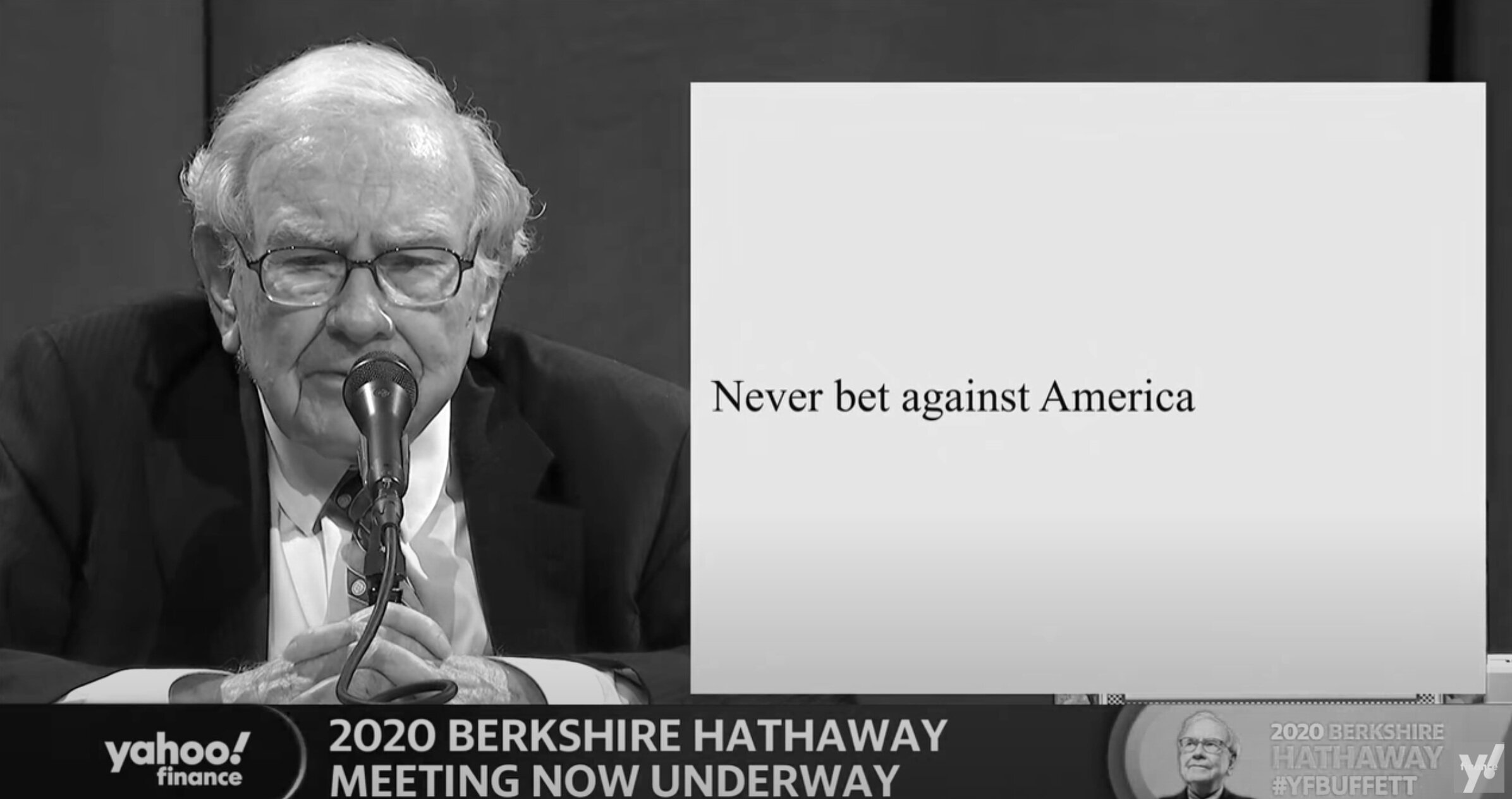
This tweet flew by about Warren Buffett’s slides during his annual investor meeting.
VCs: “please make sure you get someone to design your slides or nobody will take you seriously.”
— Yuri Sagalov (@yuris) May 2, 2020
Warren Buffet: pic.twitter.com/viu7wG17GK
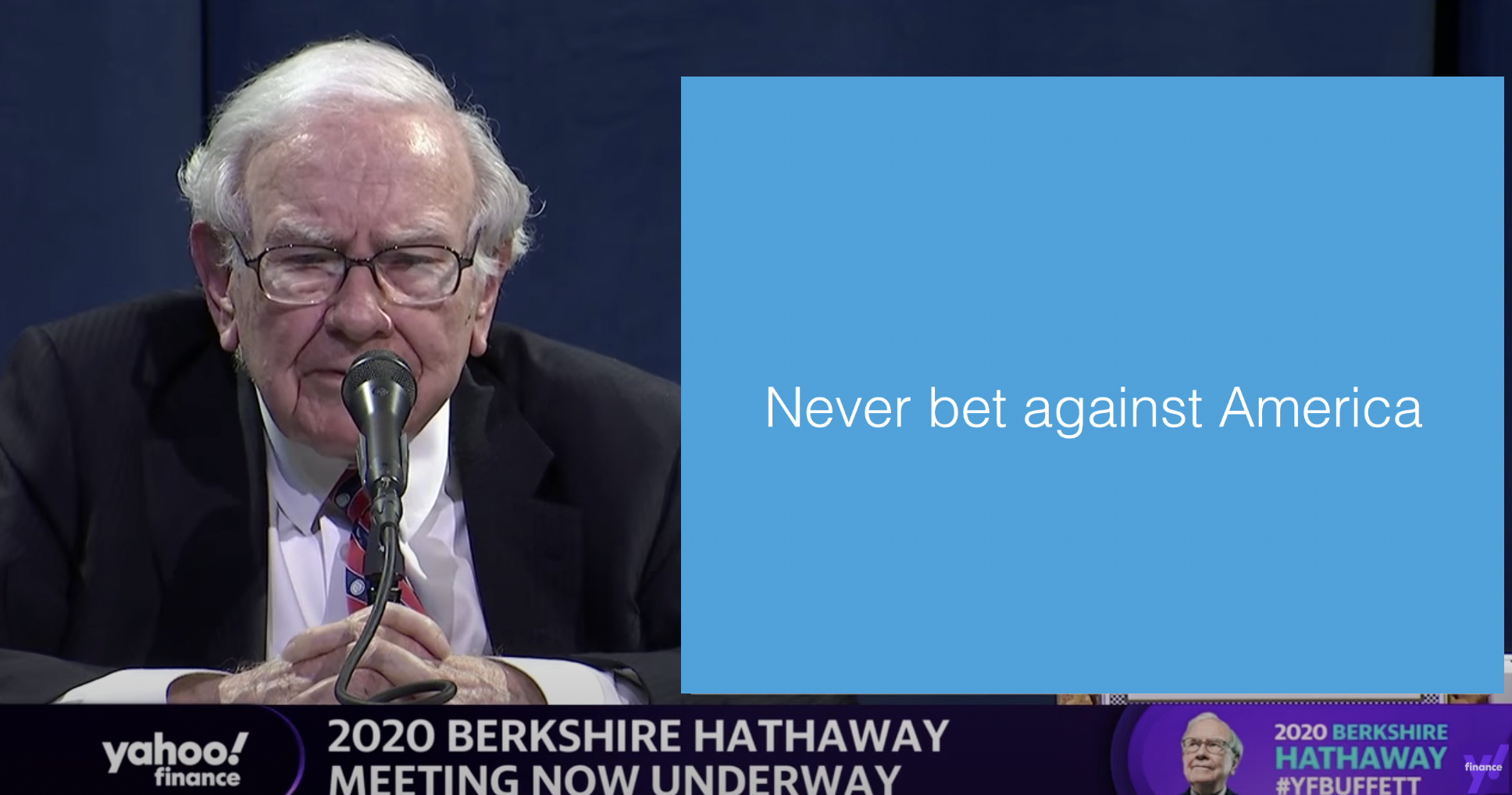
A sans serif font and centering the text would have made it look better, but overall, this slide is actually not that bad. One big message without distractions. (If Warren had used SlideMagic with this template, his slide would have looked like this)
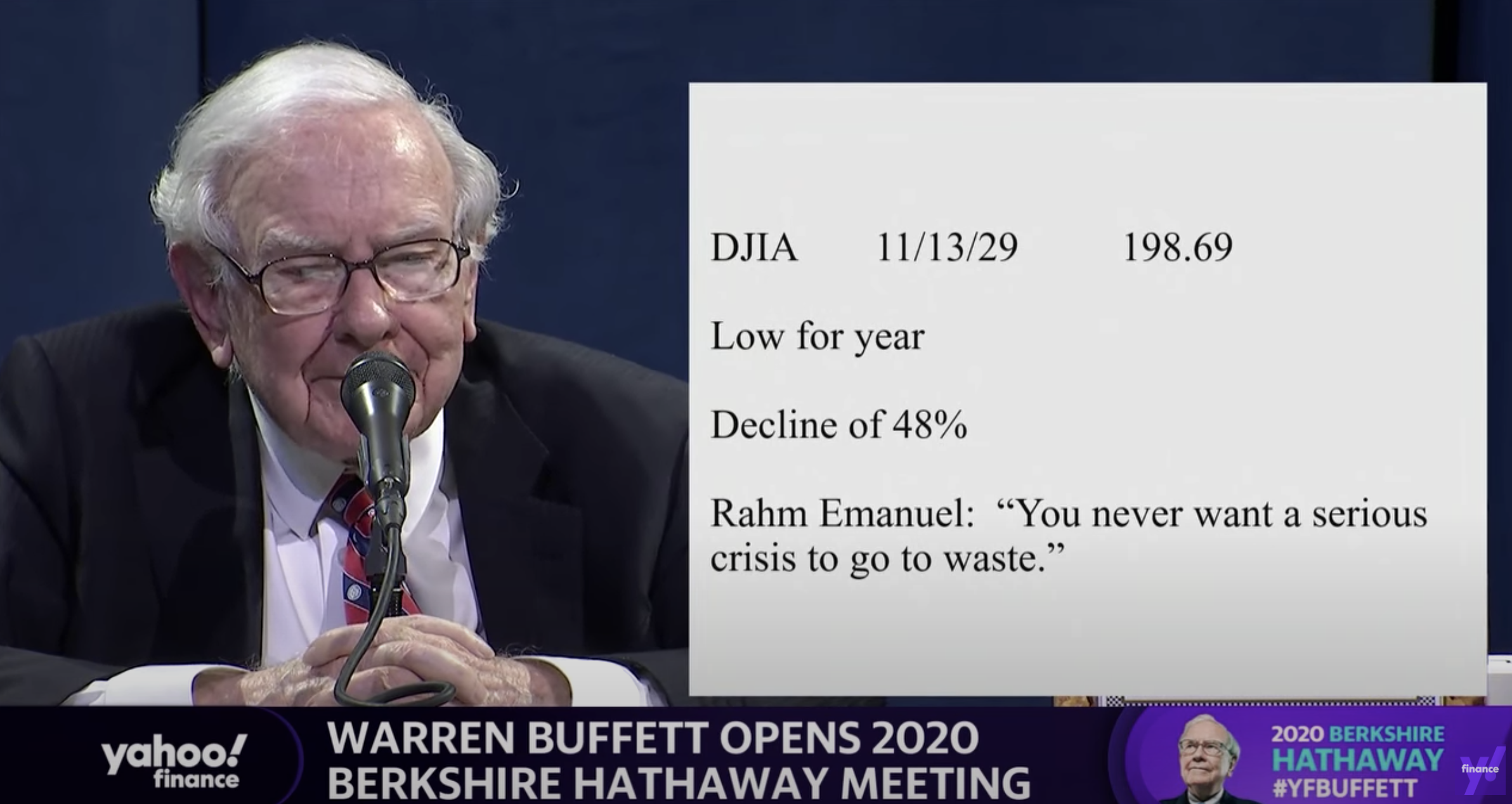
Other slides are less crisp though, as seen in the example below:
But, Warren does not read out the bullet points, he tells a story starting with background about his father. People will read the slide for 2 seconds, wonder about the quote, and then focus all attention back on him.
OK, I could not resist, SlideMagic would have produced the following slide (a quick search for “1930” in the built-in Pixabay image search delivers good results)
I would put the quote on a completely separate slide, if at all.
Coming back to the first tweet. If you are Warren Buffett, then you get away with pretty much any slide design. On the contrary, making it all too fancy is a direct contradiction to his modest life style. If you are not Warren Buffett, putting in 2 seconds worth of effort with SlideMagic will definitely make a difference.
I tagged these 2 slide examples with “buffet” in SlideMagic, you can use them in your own designs and find them in the presentation app, or download them here.
I am in the process of adding more full slide decks to SlideMagic. Now all the investment in automation starts to pay off. Creating slides is incredibly fast in the app, after that the server takes over and creates thumb nails, organises tags, uploads both individual slides as well as the full deck for download, in powerpoint 4x3, 16x9, and of course .magic format.
Today, I added a possible layout for a big corporate quarterly earnings call deck, loosely based on a recent earnings presentation of a large pharmaceutical company (these presentations are obviously in the public domain).
SlideMagic subscribers can download the earnings call presentation template here.
Let me know what other type of slide decks you are looking for.
I am preparing a few more stories to add to SlideMagic, one of which will be a sanitised box-standard quarterly earnings presentation template for a typical manufacturing company. Just stumbling on this tracker page. It probably started out good, but then the legal department got involved and put in all the disclaimers… “36 consecutive years of growth” sounds a bit better… I would have put that in the slide, and then clarified the “adjusted earnings” part all in the foot note.
36 consecutive years of adjusted operational earnings growth*
I reshuffled the code on the server, so I can now stitch entire decks (I call them “stories”) together that you can download in one go. I think these stories can complement the offering of individual slides.
Slide templates are focussed on one particular design or image that cover a certain topic
Story templates are all about well, the story. I expect them to contain mainly very simple slide layouts, what matters is what is written in them, and in what sequence they are put together.
I am starting with a quick make-over of the YCombinator seed deck, you can download it for free here. See the original post on YC for the background.
It is available both as a .pptx and a .magic file, but it with these simple slide layouts where the power of SlideMagic comes in: quickly adding or deleting rows without messing up your slide layout. You know which I would pick :-)
There is still work to do, you can’t get to the stories easily from the top slide menu. Also, the user interface can be confusing now when as a user you are not sure whether you are browsing slides or stories. Also, in-app story downloads are not your implemented . Work in progress.
YCombinator VC Paul Graham argues that the current pandemic has exposed politicians that talk confidently about things they do not understand: see the post her about credibility in corona times.
He is right
Most of these politicians probably did not knowingly lie, I assume they believed they understood things, that’s probably a key asset of being a politician
When it comes to pitching to investors, credibility is crucial, and you can only loose it once. Investors will have to work with you for a long time, they don’t have time to check everything you do, so as soon as one incident gets exposed where it appeared that they cannot trust you, that’s it.
So you get a question you do not know the answer to:
If it is factual, give the answer after you consulted with someone who knows, maybe after a short delay
If you truly don’t know, say so, with an approach how you mitigate the uncertainty.
Bluffing an answer is not the right thing to do here.
So as a startup CEO, you can still be highly confident that your idea is going to work, and keep credibility while admitting that you do not know everything, and that you might actually be wrong.
Photo by Dayne Topkin on Unsplash
Working from home means that I cannot help to overhear fragments of startups pitching to a VC (my wife is a partner in a healthcare venture capital fund).
You are in a Zoom call, going through a deck with a few people from the VC, and the senior management team of the company on the line. One of the impatient investors throws in a question on a crackling audio connection. Answer it, or (tell her to) wait for page 35?
If you were presenting to a huge crowd (webinar, live audience), then the answer is clear, tell them to wait for page 35, or even ask to leave all questions to the end.
The “intimate” Zoom call is similar to a conference room setting though that opens the door to more interaction that throws you of your planned story script. There is no general rule, but here is how I would handle the interruption.
Always give some sort of very brief answer: ‘The short answer is “yes”, it has something to do with “this and that”, we will discuss it in more detail on page 35. This takes you as much time and disruption as saying: “sorry, page 35 will show up in 20 minutes”
Then calibrate based on the sort if question. If it is a super naive question (junior analyst, VC who does not really understand the substance), maybe insist on continuing your story line so everything falls into place nicely. If it is a razor sharp question by someone who is really informed, pinpoints the exact weak point in your story, and/or addresses a big elephant in the room, you could assume that people have done their homework and know what they are talking about. Sticking to your script might not give you points here.
If it is a big interruption of your original flow, have a way to continue the story in a slightly different order, bringing everything back together for the other people in the room
If you get tripped up a lot by questions, maybe this is a sign that your story flow might not fit that of your audience. The 101 sequential story is great for explaining things to the uninitiated, but will not work for impatient experts in the field.
Photo by Ussama Azam on Unsplash
The other day I was eye balling a pitch deck and here I am jotting down my reactions as I go page by page:
Logo and colour on the front page looks nice, a grammatical error and an over used buzz word in the slogan
Vision statement instead of describing what the app is all about. Vision statement contains overused buzzwords, and lists actually multiple possible consumer hooks, each could be a business in its own right, some are features, some are business models
App screen shot looks nice, but highlighted features do not match the vision of the previous page
Lots of market data, but in this industry, no one will ever doubt that the market is small, the question is how to take on the existing giants and way of doing things
Product description (matches the screen shot, not the vision). Trying to relate this product to products I know (both traditional ones, and other innovators I am aware of). Maybe this product is new and does not merit a direct comparison, but still I am trying to understand what it actually does before getting into the positioning. Existing product comparison are good for the purpose of educating.
Very dense internal consulting chart that shows how the team came up with the value proposition
Competitive analysis is a detailed spreadsheet, competitor columns need re-ordering, feature rows need re-ordering and grouping
A key strategic partner pops up at the end of the slide deck as a very important part of the brand
This is not a critique of a final, polished investor pitch, this document was just version 0.1 of an interested customer of SlideMagic, asking me what templates to use. SlideMagic can instantly upgrade the looks of these slides, some of the consulting frameworks are on board as a template already. But designing the deck is too early.
It looks like the project started as an original product idea with a very distinctive feature. Now the team is working to build the right consumer positioning out of it and is mid-way. Some recommendations:
Keep the investor positioning and the consumer positioning separate. For investors, be very clear how your product/technology fits, relates, is different from other players in the market. The consumer pitch can sound different. You need to have a consumer pitch, since the investor wants to be confident that you know how to market, but that is a different check box you need to tick.
Separate the charts from you internal consulting project from the pitch deck, they are totally different. Not only in graphical style, but also in content. Working documents show doubts, trade offs, analysis, pitch charts have a very clear and confident message
Photo by Science in HD on Unsplash
I have been in many of these types of presentations:
Sometimes a big company does something, and you know exactly what every slide in the PowerPoint looked like, and all the slides made *sense*, and followed on logically to the conclusion... except that somehow the conclusion makes no sense.
— Benedict Evans (@benedictevans) January 17, 2020
Some of the reasons why the overall conclusion of a presentation does not make sense, while the individual slides do:
Maybe the people, the organisation, and its culture is not the right environment to make a plan happen. Who is going to do it?
The probability curve: on average, normally speaking, the strategy makes sense. But what if things start deviating from the average. What is the potential downside and could it be catastrophic to the compony?
The self-fulfilling prophecy. Yes, the deck has 50 slides, discussing 50 different aspects of the idea, but when you look at it, they all depend on ver few (maybe even one) assumption about the market outlook, a valuation of a company, etc. That assumption could be wrong.
Unlike for big companies, for tiny startups the opposite could be true. The slides might not all make sense, but the team is fantastic, the downside is not that big, and an angel investor is willing to bet on that one big assumption.
Photo by dylan nolte on Unsplash
When someone asks me for an introduction to my network with an idea that needs to be pitched, I noticed that I can be as effective in explaining the basics of an idea in a few lines in an email as an entire slide deck.
Why?
I really think about my “audience” (usually a friend or business relationship that has a lot of prior knowledge or interest in the thing I am pitching, otherwise I would not bother to make the introduction). Out go the buzzwords, the market stats, directly raising the points that are unusual, surprising, unexpected, to someone who has a decent understanding of this type of business.
Personal recommendations can be much more powerful in an informal email between friends. You cannot put “she was only the junior assistant on the team, but believe me, she single-handedly delivered that project” on a slide.
You can raise risks in an honest way that are not always detrimental to the pitch: “the whole thing hinges on whether they can get product costs down, but I think they have a good shot at it”.
Next time when you write a pitch deck, ask yourself the question, what would a friend who is doing you a favour have to write in the cover of the email? Read the resulting text, and maybe it inspires you to change your pitch deck as well.
Photo by Helloquence on Unsplash
Some useful guidance by Jason Lemkin, a VC. Two items on the list stand out:
The initial decision is made within 20 minutes of the first face-to-face. Make it exciting, speak with data, and get to the point. The initial Yes, Maybe or No decision is made within 20 minutes. So save slides 20–200 for questions and back-up.
Making stuff up is death, or close to it. If you don’t know the answer, just say that, it’s fine. But make something up that the VC knows the answer is otherwise … that’s almost always a No right there.
Photo by Jhonatan Saavedra Perales on Unsplash
A VC friend got sent a pitch the other day that sounded like an exact copy of a company that underwent a spectacular and well-known crash a few months ago. The pitch completely ignored this white elephant and followed the standard presentation structure.
It is unlikely that this copy was indeed an exact replica of the famous failure, and it is unlikely that the pitching entrepreneur would think that seasoned investors did not know about that crash.
So in your pitch, you might as well take it straight on. The highly publicised failure did already part of the work for you, that, if you get this company to work, the market expectations are pretty big. Now on to the more difficult part, why that one failed and this one won’t.
Photo by Lili Koslowksi on Unsplash